
Wi-Fi Positioning for Real-Time People Tracking
Boost visibility and safety with IPEOPLE TRACKING’s location-based solutions using advanced Wi-Fi Positioning systems.

Wi-Fi Positioning: A Smart, Scalable Tracking Solution
Wi-Fi Positioning is a powerful location-tracking technology that utilizes existing wireless networks to determine real-time locations of individuals in both indoor and outdoor settings. By analyzing signals from nearby access points, it provides a cost-effective and scalable alternative to GPS or RFID, reducing the need for extra hardware.
As industries aim for smarter space utilization, enhanced safety compliance, and improved operational efficiency, Wi-Fi Positioning stands out as a reliable and versatile solution. This technology can be seamlessly integrated into customized systems tailored to meet evolving enterprise demands across North America.
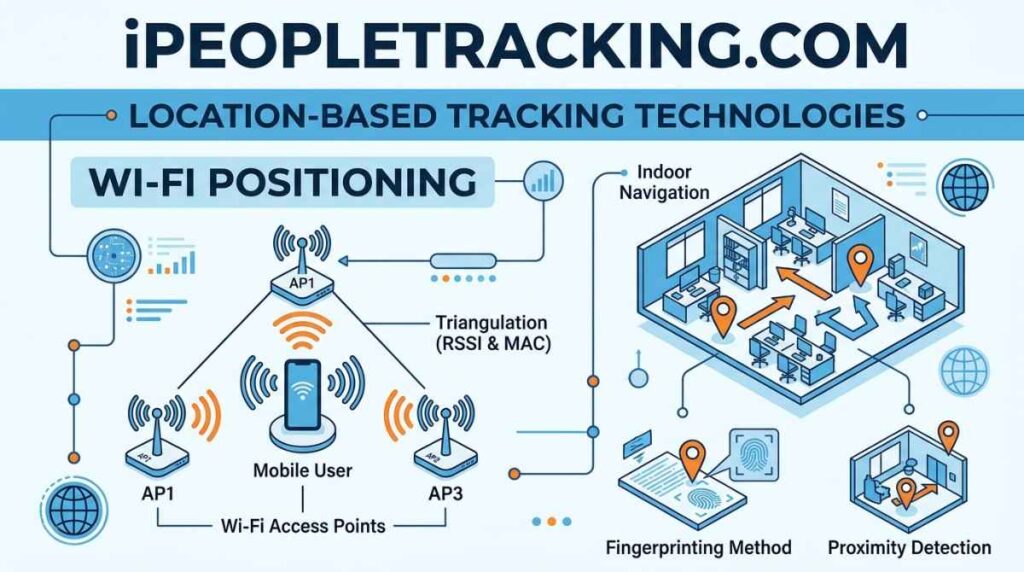
Core Components
Hardware
- Wi-Fi-enabled ID badges and wristbands:
People Tracking RFID Tags are designed for personnel identification and location monitoring using Wi-Fi or hybrid wireless protocols. - Dual-band (2.4 GHz/5 GHz) routers and access points:
Dual-Band Wi-Fi Network Router provides essential wireless infrastructure for high-speed data transfer and precise device triangulation in location tracking applications. - Optional BLE-Wi-Fi hybrid anchors for higher accuracy:
BLE Gateways, Beacons & Accessories offer integrated hardware for BLE and Wi-Fi hybrid anchors, boosting indoor location accuracy and scalable deployment. - Charging stations and mounting kits:
RFID Peripherals & Accessories deliver mounting hardware, charging docks, power supplies, and all necessary installation accessories for Wi-Fi positioning devices.
Software
- Real-time indoor tracking interface
- Location history logs and route replay
- Access and zone control features
- Custom event and rule-based alerts
Cloud Services
- Secure data hosting and encryption
- Multi-site tracking and centralized dashboard
- Custom API endpoints for third-party apps
- Scalable storage for historical tracking data
Key Features and Functionalities
- Accurate Indoor Positioning: Tracks personnel within multi-story buildings or crowded spaces.
- Real-Time Location Monitoring: Delivers continuous updates on individual movements.
- Zone-Based Alerts: Sends notifications when a person enters or exits predefined zones.
- Historical Movement Logs: Maintains records of movement patterns for auditing and analysis.
- Mobile-Friendly Interface: Allows easy access to live dashboards from smartphones, tablets, and computers.
- Privacy Controls: Ensures secure handling of personal location data with compliance features.
Integrations and Ecosystem Compatibility
IPEOPLE TRACKING’s Wi-Fi Positioning solutions are designed for seamless compatibility with:
- Legacy Wi-Fi Infrastructure from major hardware providers
- IoT Devices and Sensors including badges, wristbands, or smartphones
- Third-Party Platforms like ERP systems, building management systems, and HR software
- Custom Dashboards built using open APIs for visualization and control
Our development team ensures that our solutions integrate smoothly with existing systems, reducing the need for overhaul and minimizing deployment friction.
Benefits
- Cost-Effective Deployment: Uses existing Wi-Fi networks to minimize infrastructure costs.
- High Scalability: Easily scale across large or multi-site facilities.
- Low Maintenance: Centralized system management with over-the-air updates.
- Actionable Insights: Provides data to improve operations, safety, and productivity.
- Fast Implementation: Minimal setup time with guided deployment support from our team.
Real-World Applications & Use Cases
From hospitals to government buildings, Wi-Fi Positioning empowers teams to monitor movement, optimize space, and improve safety in real time.
- Hospitals & Clinics: Track real-time locations of staff and patients to improve response times and shift coordination.
- Education Campuses: Monitor student and faculty movement to enhance safety, attendance, and emergency drills.
- Corporate Offices: Log employee presence and optimize workspace utilization.
- Retail & Malls: Track security personnel and support real-time incident management.
- Event Venues: Manage crowd flow and staff positioning during large events or emergencies.
- Government Buildings & Museums: Monitor visitors, ensure security, and support evacuation protocols.
Industries We Serve
- Healthcare & Medical Facilities
- Education & Campus Security
- Corporate Offices & Enterprises
- Public Safety & Event Management
- Government & Civic Buildings
- Retail & Shopping Centers
Case Studies

Seattle, WA
A university campus in Seattle implemented Wi-Fi-based tracking to monitor student movement across multiple buildings. This enabled location-based alerts during emergency drills and reduced unauthorized access to restricted areas by over 30%.
Atlanta, GA
A large regional hospital in Atlanta integrated Wi-Fi tracking across all departments to streamline nurse assignments and optimize patient rounds. The platform also allows faster patient response and real-time compliance tracking.
Toronto, ON, Canada
A municipal government office in Toronto installed Wi-Fi positioning solutions to enhance building security and staff monitoring. The system helped identify underutilized zones and supported emergency evacuation procedures with live occupant data. Similar applications can benefit from connected workforce tracking and positioning technologies, which support personnel visibility, occupancy monitoring, and safety coordination across complex facilities.
Relevant U.S. & Canadian Industry Standards and Regulations
- FCC Part 15 – Radio Frequency Device Standards (USA)
- OSHA 1910 – General Industry Regulations (USA)
- HIPAA – Patient Data Security Compliance (USA)
- PIPEDA – Personal Information Protection (Canada)
- CSA T530 – Communication and Security Devices (Canada)
Ready to upgrade your facility with real-time Wi-Fi-based people tracking?
Contact iPeople Tracking for a tailored solution, expert support, and a free consultation. Let’s transform how you monitor, manage, and protect your people.
Frequently Asked Questions About Location-Based Tracking Technologies
Find answers to common questions about location-based tracking technologies, indoor and outdoor positioning, real-time people tracking, and choosing the right solution for your organization.
1. What are location-based tracking technologies?
Location-based tracking technologies use wireless signals, sensors, and positioning systems to identify and monitor the location of people, equipment, or assets. Common technologies include GPS, Bluetooth Low Energy (BLE), Ultra-Wideband (UWB), RFID, Wi-Fi positioning, and cellular tracking. Organizations use these technologies to improve personnel visibility, workplace safety, access management, and operational efficiency.
2. How does a location-based tracking system work?
A location-based tracking system collects signals from devices such as wearable tags, RFID badges, smartphones, or tracking sensors. Receivers, gateways, or satellite signals help determine the location of a person or asset. The collected information is transmitted to centralized software, where authorized users can view location updates, monitor movement, configure alerts, and generate reports.
3. What is the difference between GPS and indoor location tracking?
GPS uses satellite signals to determine outdoor locations and is commonly used across construction sites, campuses, and transportation routes. Indoor tracking uses technologies such as BLE, UWB, RFID, and Wi-Fi because satellite signals may be unreliable inside buildings. The appropriate solution depends on the required accuracy, facility layout, coverage, and tracking objectives.
4. Which technology is best for real-time people tracking?
The best technology depends on the tracking environment and required accuracy. GPS is suitable for outdoor tracking, UWB supports high-precision indoor positioning, and BLE provides cost-effective proximity and zone monitoring. RFID is useful for identification and checkpoint events, while Wi-Fi can leverage existing network infrastructure. Combining multiple technologies can provide broader coverage.
5. What is the difference between RTLS and GPS tracking?
Real-Time Location Systems (RTLS) use technologies such as UWB, BLE, Wi-Fi, and active RFID to locate people and assets within a defined environment, particularly indoors. GPS tracking uses satellite signals to determine geographic positions, primarily outdoors. RTLS can support detailed facility-level visibility, while GPS is more suitable for wide-area outdoor tracking.
6. Can location-based tracking technologies work indoors and outdoors?
Yes. Organizations can combine GPS with indoor positioning technologies such as UWB, BLE, Wi-Fi, and RFID to support tracking across indoor and outdoor environments. A hybrid tracking system can help maintain location visibility as personnel move between buildings, outdoor work areas, warehouses, and other operational zones.
7. How accurate are location-based tracking systems?
Tracking accuracy varies depending on the technology, infrastructure, environmental conditions, and installation. GPS generally provides outdoor positioning, while UWB can support centimeter-level accuracy under suitable conditions. BLE and Wi-Fi typically provide proximity or zone-level positioning, and RFID accuracy depends on reader configuration and tag detection range.
8. What industries use location-based tracking solutions?
Location-based tracking solutions are used in healthcare, manufacturing, construction, logistics, warehousing, education, public safety, and large commercial facilities. Common applications include employee location monitoring, patient and staff visibility, lone-worker safety, restricted-area access monitoring, emergency response, and workforce coordination.
9. Can location-based tracking systems improve workplace safety?
Yes. Location-based tracking systems can help organizations identify personnel in hazardous areas, monitor restricted-zone access, locate lone workers, and provide location information during emergencies. When integrated with wearable devices and safety sensors, these systems can also support alerts for defined safety events and improve emergency response coordination.
10. What factors should organizations consider when choosing a location tracking solution?
Organizations should evaluate tracking accuracy, indoor and outdoor coverage, infrastructure requirements, scalability, device battery life, integration capabilities, data privacy, and deployment costs. The number of people being tracked and the physical environment also matter. Selecting the right combination of GPS, UWB, BLE, RFID, or Wi-Fi helps meet operational requirements.
Still Have Questions About Location Tracking?
Talk to our team about choosing the right tracking technology for your organization.
Contact Our Experts →