
NFC-Based RFID Technology for Secure NFC People Tracking System
NFC People Tracking System identifies employees, visitors and staff when they tap an NFC card, badge or wristband on a reader. IPEOPLE TRACKING provides NFC readers, credentials and software that record check-ins, attendance and access events in one dashboard.

What Is NFC People Tracking?
NFC People Tracking System is a method of identifying individuals through NFC-enabled cards, badges or wristbands. When a person taps a credential on a compatible reader, the NFC tracking system can record an identification, attendance or access event in connected software. Organizations can combine NFC technology with wearable-based people tracking and RFID people tracking to support more comprehensive personnel identification and monitoring.
NFC, or Near Field Communication, is a short-range wireless technology that operates at 13.56 MHz and typically works over a few centimeters. It is based on high-frequency RFID, which makes it well suited to deliberate, secure identification rather than long-range scanning. For applications requiring broader movement visibility, organizations can also explore BLE-based tracking technologies and other people tracking technologies.
Organizations use NFC personnel tracking for employee attendance, access control, visitor management and checkpoint verification in hospitals, schools, offices, event venues and secure facilities. These applications can also integrate with employee attendance tracking and access control solutions to improve personnel management and facility security.
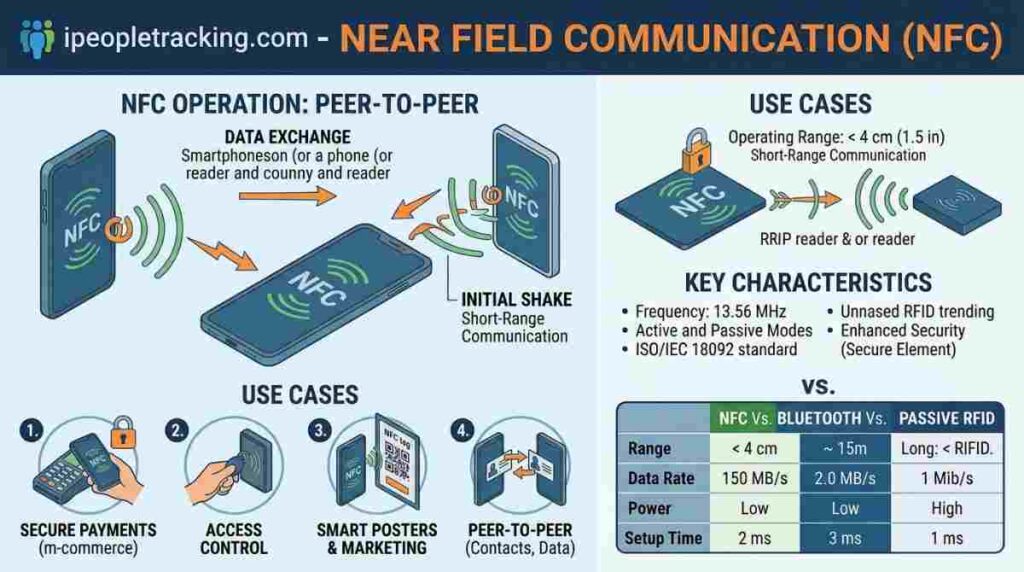
Next-Generation People Tracking Powered by NFC
Near Field Communication (NFC) revolutionizes contactless identification through short-range wireless communication, enabling fast and seamless interactions between compatible devices without the need for complex configurations. This makes it an ideal choice for people tracking applications where efficiency, convenience, and data integrity are critical.
By integrating NFC into people tracking systems, organizations can benefit from secure, intuitive, and real-time identification solutions tailored for dynamic environments. Backed by a strong foundation of research-driven development and collaborative partnerships, these NFC-based systems support scalable, reliable operations across diverse sectors throughout North America.
Core Components
Hardware
- NFC Access Control Reader – NEAR FIELD COMMUNICATION (NFC) READERS
Compact desktop or wall-mount NFC reader designed for personnel and visitor identification; supports fast, secure reading of NFC-enabled wristbands, cards, or mobile devices for check-in, attendance, and access control in offices, events, or healthcare environments.
- NFC Wristband/Badge Tag – NFC RFID TAGS
Wearable NFC RFID wristbands or badges used for people tracking and identification; battery-free, durable tags compatible with NFC readers for rapid check-in, access control, and personnel location logging across facilities, campuses, or events.
- NFC Personnel Tracking Kit – NFC & HF Readers, Tags & Accessories
All-in-one hardware kit including an NFC reader and compatible NFC wristbands or badges, designed for rapid, secure employee, visitor, or patient identification and attendance management in offices, healthcare, events, or campuses.
Software
- Secure credential management systems
- Access event tracking with time-stamped logs
- Custom rule-based access controls
Cloud Services
- Remote provisioning of credentials
- Audit-ready reporting via web portals
- Data encryption and secure cloud storage
Key Features and Functionalities NFC People Tracking system
- Contactless Interaction: Requires only a tap or proximity
- Authentication: Supports identity verification and access control
- Data Syncing: Real-time updates to centralized systems
- Encryption: Secures transmission of sensitive data
- User-Friendly Interface: Simplified operations for staff and users
Integrations and Ecosystem Compatibility
- ERP and HR Systems: Seamless employee and data integration
- IoT Devices: Integration with BLE, GPS, and RFID readers
- Cloud Services: Scalable and secure cloud database connectivity
Benefits
- Improved Efficiency: Faster processing and access
- Enhanced Security: Reduces unauthorized access and identity misuse
- Scalability: Easily expand systems with minimal hardware investment
- Cost-Effectiveness: No need for power supply to tags
- Minimal Maintenance: Durable tags and simple infrastructure
Real-World Applications & Use Cases
- Educational Institutions – Track student attendance, secure campus access
- Healthcare Facilities – Staff authentication for sensitive areas like labs and medicine storage
- Corporate Offices – Employee check-in, zone control, and time tracking
- Event Venues – Manage attendee access through NFC-enabled badges
- Public Transit & Municipal Buildings – Validate riders and staff with NFC cards
- Government & Research Labs – Combine access control with usage monitoring
Industries We Serve
- Education & Universities
- Healthcare & Clinics
- Corporate Offices
- Government Facilities
- Logistics & Warehousing
Case Studies

San Diego, California
A major healthcare network adopted NFC-based ID badges to monitor staff access to medication storage and sensitive patient areas. The solution enhanced compliance with HIPAA and internal access policies without slowing workflow.
Atlanta, Georgia
A school district deployed NFC wristbands for student check-in and campus movement tracking. The implementation reduced unauthorized leave incidents and improved parental confidence in student safety.
Vancouver, British Columbia
A public research facility in Vancouver implemented NFC-enabled access cards integrated with time logging systems to maintain facility usage transparency and equipment accountability.
Relevant U.S. & Canadian Industry Standards and Regulations
- ISO/IEC 14443
- ISO/IEC 18092
- FIPS 201
- CAN/ULC-S319
- OSHA 1910 Subpart E
Our Commitment to You
We prioritize innovation, reliability, and your operational success. Every solution is developed through rigorous testing, supported by a robust quality assurance process, and guided by experienced teams. Through strong industry collaborations and industrial IoT technology solutions, we deliver cutting-edge technologies that adapt and scale with your evolving needs.
Discover how NFC technology can improve your people tracking operations.
Contact IPEOPLE TRACKING today to learn more, request a demo, or speak with a solutions expert from IPEOPLE TRACKING.
FAQs
Find answers to common questions about NFC people tracking, NFC technology, employee attendance, access control, and real-time location tracking.
What is NFC people tracking?
NFC people tracking identifies individuals through NFC cards, badges, or wristbands. When someone taps a credential on a compatible reader, the system records an identification, attendance, or access event in connected software. It tracks verified check-ins and checkpoint events rather than continuous movement.
How does NFC tracking work?
A person taps an NFC credential on a compatible reader. The reader retrieves the credential data, and the tracking software matches it to an authorized record. The system then logs the time and location of the tap. Authorized users can view the results through a centralized dashboard or report.
Can NFC track employees?
Yes. NFC employee tracking can record when employees check in, check out, or enter restricted areas by tapping their NFC cards or badges on readers. However, NFC does not continuously follow employees throughout a building. Organizations can combine NFC with BLE or UWB technology for more frequent indoor location updates.
What is the difference between NFC and RFID?
NFC is a short-range technology based on high-frequency RFID that operates at 13.56 MHz. General RFID also includes low-frequency and ultra-high-frequency systems with longer reading ranges. NFC is ideal for deliberate taps, access control, and identification, while other RFID technologies are commonly used for inventory management and automatic identification.
What is the operating frequency of NFC?
NFC operates at 13.56 MHz within the high-frequency (HF) band. This is the same frequency used by many contactless smart cards. Typical NFC communication takes place over a few centimeters, making it suitable for tap-based identification, attendance systems, and contactless access control.
Can NFC provide real-time location tracking?
NFC does not provide continuous real-time location tracking on its own. It records an event when a person taps a reader, showing where and when the interaction occurred. For automatic or continuous indoor location updates, organizations can use BLE, UWB, or other real-time location systems (RTLS).
Do NFC tags require batteries?
Most NFC cards, wristbands, and tags do not require batteries. They are passive devices powered by the electromagnetic field generated by a compatible NFC reader during communication. Readers and smartphones require power, while some specialized active NFC devices may use batteries.
What is the difference between NFC and BLE?
NFC works over a few centimeters and generally requires a deliberate tap, making it suitable for attendance, access control, and identity verification. Bluetooth Low Energy (BLE) operates over longer distances and can detect compatible devices automatically. BLE is more suitable for proximity detection and indoor location tracking, while NFC is commonly used for short-range identification.
Can NFC wristbands be used for attendance tracking?
Yes. NFC wristbands can be used for employee, student, and event attendance tracking. Users tap their wristbands on compatible NFC readers to record check-in and check-out times. The connected software stores each event and generates attendance records and reports.
How much does an NFC people tracking system cost?
The cost of an NFC people tracking system depends on the number of users, NFC readers, credential types, software features, and required integrations. A small attendance solution generally costs less than a multi-site access control deployment. Contact IPEOPLE TRACKING to discuss your requirements and request a customized quote.