
01
Infrared Radiation Reaches the Sensor
Infrared radiation enters through a lens or window designed to pass infrared wavelengths. PIR sensors typically use a Fresnel lens to divide the field of view into detection zones.
People Tracking with Passive RFID Infrared sensors detect heat and motion without cameras. IPEOPLE TRACKING combines PIR motion sensing, thermal sensing and BLE connectivity to support presence monitoring, occupancy analytics and safety alerts in indoor spaces.

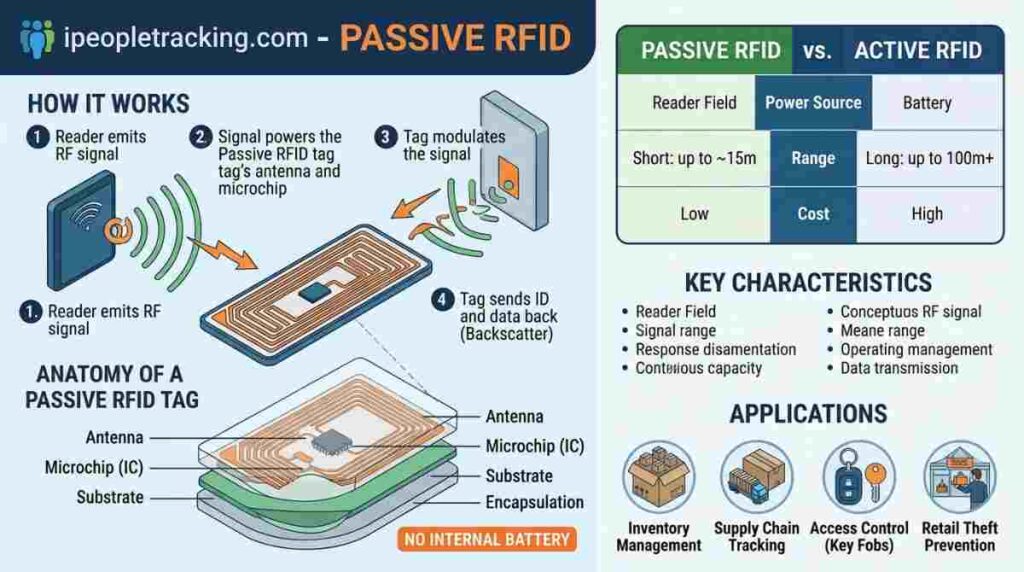
People tracking with passive RFID is a method of identifying and monitoring individuals using battery-free RFID tags, wearable badges, wristbands, and strategically installed RFID readers. Unlike active RFID systems, passive RFID tags do not contain an internal battery. They receive energy from the radio-frequency signal sent by a reader and respond with their unique identification information.
When a person carrying a passive RFID tag passes through a configured reader zone or checkpoint, the system can record their presence, entry, exit, or movement event. Organizations use this information to support personnel identification, attendance management, access control, and movement monitoring. To understand the broader technology behind these applications, explore Radio Frequency Identification (RFID) and Related Technologies.
Infrared sensors detect infrared radiation emitted by objects and convert it into electrical signals. Their internal electronics process these signals to identify motion, detect presence, or measure temperature, depending on the sensor type.
Every object above absolute zero emits infrared radiation, and warmer objects, including the human body, emit more of it. An infrared sensor contains a detector that converts incoming infrared energy into an electrical signal, which onboard electronics then process.
Infrared radiation enters through a lens or window designed to pass infrared wavelengths. PIR sensors typically use a Fresnel lens to divide the field of view into detection zones.
Pyroelectric elements respond to changes in infrared energy. Thermopile and microbolometer detectors measure absolute heat levels. The detector type determines how the sensor responds to infrared radiation.
The circuit processes the detector's electrical output and compares it against configured thresholds. It determines whether a motion event, presence condition, or temperature reading has been detected.
The sensor can trigger a relay, send a digital signal, or transmit an event to a gateway or connected platform. This allows authorized systems to process sensor readings and generate relevant alerts.
Passive RFID technology has become a cornerstone in modern people tracking due to its cost-effectiveness, scalability, and versatility. This system operates without batteries, drawing power from RFID readers, making it ideal for long-term deployments in large-scale environments. It enables real-time visibility and improves security, efficiency, and accountability in the workforce and crowd management applications.
We deliver tailored Passive RFID solutions designed to meet diverse industry needs. With minimal maintenance and a high degree of customization, our Passive RFID systems empower businesses to optimize operations while maintaining low overhead costs.

A large hospital system implemented passive RFID badges and readers to track movement of medical staff and ensure compliance with restricted area protocols. The solution reduced unauthorized entries and improved patient data security across multiple buildings.
A multi-tower office complex used passive RFID to automate entry logs and evacuation roll calls. The system significantly shortened emergency response times and eliminated manual sign-in procedures.
A Canadian university deployed RFID-enabled access gates and ID cards to monitor student flow into labs and research centers. The passive system supported both real-time entry control and historical usage analytics.
Our promise is centered around empowering organizations with reliable and innovative people tracking solutions. Every system is backed by rigorous quality control and enhanced through collaboration with trusted industry partners. We deliver expert consultation, tailored deployment, and dedicated post-sale support to ensure long-term value and performance.
Proudly headquartered in Arlington, VA, we serve businesses across North America—bringing advanced, people-focused technologies to the forefront of workplace and operational safety.
Contact IPEOPLE TRACKING today for more information, expert consultation, or personalized support. We’re here to help you make smart move towards scalable, dependable people tracking.
Find answers to common questions about passive RFID technology, how it works, its read range, applications, and people tracking capabilities.
Passive RFID people tracking identifies and monitors individuals using battery-free RFID tags, badges, or wristbands and fixed readers. When a person's tag passes a reader zone, the system records the event. It supports identification, attendance, access control, and checkpoint movement monitoring.
A reader sends a radio signal, and a nearby passive tag harvests energy from it and replies with its unique ID using backscatter communication. Software matches the ID to a person and logs the event, such as an entry, exit, or checkpoint pass, on a dashboard.
Yes, in a checkpoint sense. Passive RFID can record when employees enter or leave areas where readers are installed, supporting attendance, access control, and headcounts. It does not continuously track exact positions, and employers should communicate policies and follow applicable privacy and employment laws.
No. Passive RFID tags have no battery. They draw power from the reader's radio signal when they are within range and respond with their ID. Readers, however, need power, and active RFID tags do use batteries.
Read range depends on frequency, reader power, antenna, tag design, and the environment, so there is no single number. LF and HF tags generally work at short distances, while UHF can read from farther away. Test tags in your real environment to confirm performance.
Passive RFID gives near-real-time detection events at reader zones, but standard systems do not continuously calculate position. For frequent location updates, organizations may use active RFID, BLE, UWB, or an RTLS, often alongside passive RFID at checkpoints.
Passive tags have no battery and respond using energy from a reader, so they suit identification and checkpoint monitoring at lower cost. Active tags have a battery and transmit by themselves, supporting longer range and more frequent location updates, but need battery maintenance.
Industries include healthcare, construction, corporate offices, education, and event management. They use passive RFID for staff and visitor identification, attendance, access control, headcounts, and evacuation roll calls at defined checkpoints.
Yes, at the zones where readers are installed, such as doors, corridors, and gates. Passive RFID can show when a person passes a checkpoint but does not give continuous indoor positioning. Combining it with BLE or UWB can add more detailed location.
Cost depends on the number of tags, tag types, the number of readers and antennas, software and integration needs, and the size of the site. Passive tags typically cost less than active ones. A site assessment provides the most accurate estimate for your environment.