
Smart People Tracking with Active RFID Technology
Scalable and real-time Active RFID solutions tailored for seamless people tracking across industries.
iPeople Tracking provides active RFID tracking solutions that use battery-powered tags, readers, and software to monitor people and assets across larger areas.

What Is Active RFID Technology?
Active RFID (Radio Frequency Identification) is a wireless tracking technology that uses battery-powered tags to transmit radio signals to nearby RFID readers. Unlike passive RFID tags, which rely on energy from a reader to communicate, active RFID tags have their own power source and can transmit signals independently. This lets organizations monitor people, employees, patients, visitors, and assets across larger areas.
Active RFID tracking systems can support location monitoring, zone-based alerts, access control, and movement reporting, depending on the tag, reader infrastructure, and tracking software. This page is part of iPeople Tracking’s RFID tracking solutions.
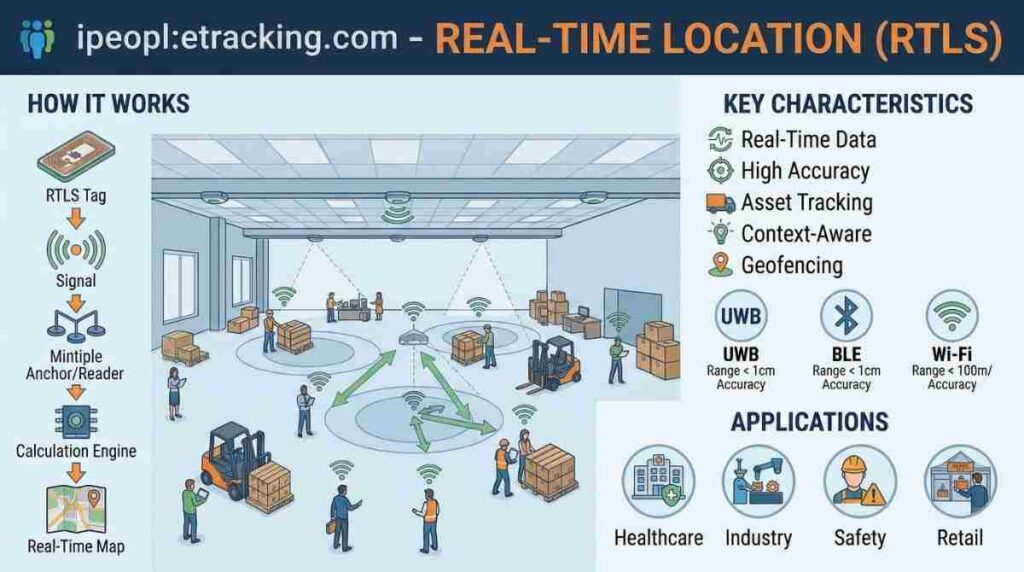
Real-Time People Tracking with Active RFID
Active RFID technology empowers organizations with precise, real-time people tracking across large and dynamic environments. Unlike passive systems, Active RFID tags continuously transmit signals, enabling constant location visibility and movement monitoring. With extended read ranges and strong signal reliability, this technology is particularly effective in settings such as healthcare facilities, construction zones, school campuses, and large-scale events.
These systems contribute significantly to enhancing safety, streamlining operational workflows, and simplifying access control. Through ongoing research, development, and industry collaboration, powerful Active RFID solutions are now available to meet the evolving needs of modern enterprises throughout North America.
Core Components
Hardware
- Active RFID wristbands and tags – Active 433 MHz RFID Tags deliver real-time, long-range people tracking with motion and tamper detection.
- Active RFID readers – Active 433 MHz RFID Readers automate active tag scanning, zone entry monitoring, and alert notification across large facilities.
- Signal repeaters and antennas – RFID Antennas extend and optimize active RFID coverage for seamless people tracking throughout buildings and campuses.
Software
- Real-time location tracking dashboard
- Configurable rules for entry/exit, time-on-site, and proximity alerts
- Visual heatmaps and path replay for behavioral analytics
- Remote device management and tag health monitoring
Cloud Services
- Centralized cloud-based server infrastructure
- Secure data storage with end-to-end encryption
- Real-time analytics and automated reporting
- 24/7 platform accessibility via browser or mobile app
Key Features and Functionalities
- Real-Time Location Tracking: Track individuals in real-time across large facilities.
- Long-Range Detection: Tags can be detected from distances up to 100 meters.
- Automatic Alerts: Send alerts for restricted area breaches or emergency situations.
- Scalability: Easily supports thousands of users and large environments.
- Battery Monitoring: Low-battery alerts for uninterrupted tracking.
- Access Control Integration: Seamlessly integrates with security systems.
Integrations and Ecosystem Compatibility
Our Active RFID system integrates effortlessly with existing infrastructure, including:
- Wi-Fi and BLE networks
- Access control platforms
- Security monitoring tools
- Enterprise resource planning (ERP) systems
- Cloud-based analytics dashboards
Benefits
- Increased Safety: Instant alerts for potential threats or emergencies.
- Operational Efficiency: Automates location tracking and reduces manual overhead.
- Improved Compliance: Helps meet regulatory standards and internal protocols.
- Cost-Efficiency: Reduces the cost of manual checks and personnel audits.
- Enhanced Visibility: Real-time insights into better decision-making.
Real-World Applications & Use Cases
- Healthcare Facilities – Track staff and patients to enhance safety and reduce response times
- Construction Sites – Monitor worker movement for compliance and emergency preparedness
- Educational Campuses – Improve student security and automate attendance tracking
- Corporate Offices – Manage access control and monitor key area presence
- Events & Venues – Coordinate attendees and staff, support crowd control
- Contact Tracing – Proximity alerts and incident history for outbreak management
Industries We Serve
- Healthcare & Assisted Living
- Industrial Manufacturing & Warehousing
- Government & Public Safety
- Education & Campus Security
- Event Management & Hospitality
- Research & High-Security Facilities
Case Studies

Houston, TX
In Houston, a major hospital implemented Active RFID wristbands to monitor patient and staff movement across multiple departments. This enabled emergency response planning and compliance reporting while ensuring patient safety and asset allocation.
Seattle, WA
A large-scale event venue in Seattle deployed Active RFID badges for all staff and volunteers. The system allowed real-time access control, zone-level monitoring, and quick emergency evacuation coordination through heatmap visualizations.
Toronto, ON, Canada
A manufacturing plant in Toronto used Active RFID tracking to monitor contractors and employees in restricted zones. The system ensured compliance with safety protocols and automated time logs for payroll integration.
Relevant U.S. & Canadian Industry Standards and Regulations
- ISO/IEC 18000-7 (Active RFID Standard)
- FCC Part 15 – Radio Frequency Devices (USA)
- OSHA 1910 – General Industry Safety Regulations (USA)
- PIPEDA – Personal Information Protection (Canada)
- CSA C22.2 No. 61010 – Safety for Electrical Equipment (Canada)
Our Commitment to You
We don’t just deliver products—we build trusted partnerships. Our commitment begins with understanding your unique operational needs and continues with providing customized, high-performance solutions that grow with your business.
- Customer-Centric Support: A dedicated expert team guides you from consultation to implementation and beyond.
- Proven Reliability: Rigorous quality assurance processes ensure every solution exceeds expectations.
- Technology You Can Trust: Our systems are built on cutting-edge research and evolve to meet changing demands.
- Collaborative Innovation: We stay at the forefront of the industry by working closely with leading technology providers and exploring OEM technology solutions that support customized products and scalable business requirements.
Choosing us means gaining a partner who’s invested in your success—every step of the way.
Interested in learning more or ready to transform your tracking capabilities?
Contact IPEOPLE TRACKING today for personalized support, detailed information, or to schedule a consultation. We’re here to help you unlock the full potential of Active RFID technology.
Active RFID – Frequently Asked Questions
Find answers to common questions about active RFID technology, tracking systems, tags, readers, and applications.
What is active RFID?
Active RFID is a wireless tracking technology that uses battery-powered tags to transmit radio signals to RFID readers. Because the tags have their own power source, they can transmit independently over longer distances than passive tags, supporting people and asset tracking, zone monitoring, and alerts.
How does an active RFID tracking system work?
Battery-powered tags transmit signals periodically or continuously. Readers and antennas receive them and pass the data to tracking software, which determines location or zone and shows it on a dashboard. The software can send alerts, such as entry into a restricted area, and keep historical records.
What is the difference between active and passive RFID?
Active tags have a battery and transmit by themselves, supporting longer range and more frequent location updates, but they cost more and need battery maintenance. Passive tags have no battery and respond only when powered by a reader, which suits identification and checkpoint detection.
Do active RFID tags require batteries?
Yes. Active RFID tags contain a battery that powers their transmitter. Battery life depends on battery capacity and how often the tag transmits, and systems often monitor tag battery levels so batteries can be replaced before tags stop working.
How far can active RFID tags transmit?
Range depends on the tag's transmit power, frequency, reader sensitivity, antenna placement, building materials, and interference. Active systems generally cover longer distances than passive ones.
Can active RFID track employees in real time?
Active RFID can provide frequent, near-real-time updates on which zone an employee is in, depending on tag settings and reader coverage. Precision depends on how many readers are installed and where. Employers should set clear policies and follow applicable privacy and employment laws.
What frequency does active RFID use?
Many active RFID people tracking systems use the 433 MHz band, and some use 2.4 GHz. The exact frequency and permitted power depend on the product and the country's radio regulations.
How long does an active RFID battery last?
Battery life varies with battery size, transmission interval, and features, and can range from months to several years. A tag that transmits less often lasts longer. Check the manufacturer's specification for the specific tag and its transmission rate.
What industries use active RFID tracking?
Active RFID is used in healthcare, construction, industrial facilities, education, corporate campuses, and events to track staff, patients, visitors, and contractors, and to monitor restricted areas, run musters, and improve safety.
How much does an active RFID tracking system cost?
Cost depends on the number and type of tags, readers, antennas, and repeaters, software licenses, installation requirements, and integration needs. Larger facilities need more infrastructure. A site assessment gives the most accurate quote for your environment.