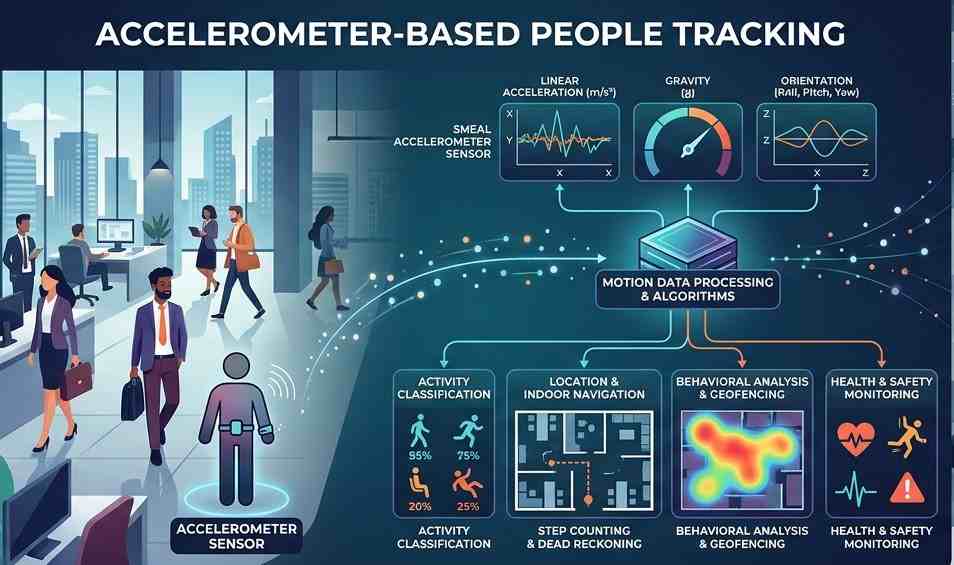
Accelerometer-Based Tracking for People Technology

Wearable motion sensing for Accelerometer-Based Tracking for People, safety monitoring, activity recognition, and fall detection across healthcare, industrial, and campus environments.

wearable based tracking

Real-Time Accelerometer-Based Tracking for People

Accelerometer-based people tracking is a wearable sensing technology that measures changes in acceleration along three axes (X, Y, and Z) to identify human movement, physical activity, and motion patterns. It is used in smart wearables, employee safety systems, healthcare monitoring, and activity recognition applications.

An accelerometer measures acceleration, which means it can tell a system when a person is walking, running, sitting, standing still, or moving suddenly. On its own it does not report absolute geographic position. When accelerometer data is combined with gyroscopes and positioning technologies such as Bluetooth Low Energy (BLE), UWB, or GPS, it can support both indoor and outdoor tracking applications.

Because accelerometers work without GPS signals or line of sight, they are well suited to indoor and hybrid environments where satellite positioning is unreliable. Integrated into wearables and IoT platforms, they support safer workplaces, proactive care, and behavioral insight. They are one of several sensor and wearable-based tracking technologies we deploy.

Accelerometer-Based Tracking for People

How Accelerometer-Based Tracking Works

A wearable accelerometer senses movement, software filters and interprets the signal, and the system sends alerts and activity data to a dashboard.

  1. Motion sensing. The wearable’s accelerometer measures acceleration along the X, Y, and Z axes.
  2. Data collection. The device records movement readings continuously or at set intervals, depending on the use case and battery requirements.
  3. Signal processing. Software filters sensor noise and separates meaningful movement patterns from the constant pull of gravity and other sensor effects.
  4. Activity recognition. Algorithms analyze the processed signal to identify activities such as walking, running, sitting, idling, or sudden movement.
  5. Alert generation. Configurable rules or machine-learning models flag potential falls, impacts, or prolonged inactivity.
  6. Data transmission. Relevant data is sent over Bluetooth Low Energy, Wi-Fi, cellular, or another link to a gateway or cloud platform.
  7. Dashboard monitoring. Authorized staff review live status, notifications, and historical reports.

How accelerometers detect human movement

Every body movement produces a distinct acceleration pattern. Walking creates a regular, repeating rhythm of peaks. Running produces stronger, faster peaks. Sitting or standing still shows little change beyond gravity. A fall typically shows a brief drop in acceleration, a sharp impact spike, and then little or no movement. Software compares these signatures against thresholds or trained models to classify what the wearer is doing.

Core Types of Accelerometers Used in Wearable Tracking

Type

What it measures

Typical use

1-axis

Acceleration in one direction

Simple vibration or impact detection

2-axis

Acceleration in two directions (a plane)

Basic tilt and planar movement

3-axis

Acceleration in X, Y, and Z

Human motion tracking, activity recognition, fall detection

Wearable people-tracking devices almost always use 3-axis MEMS (micro-electromechanical systems) accelerometers, because they capture movement in every direction while staying small, light, and power-efficient enough to embed in a wristband, badge, or shoe.

Where the wearable is worn matters

  • Wrist: convenient and widely accepted; good for activity and step data, but arm movement adds noise.
  • Waist or hip: close to the body’s center of mass, which often improves gait and fall detection.
  • Ankle or shoe: strong for step and gait analysis. See our smart shoes page.
  • Vest or ID badge: practical for workplace deployments where staff already wear them.

Detection accuracy depends on placement, so the right location should be chosen for each use case and tested before full rollout.

Core Components of Accelerometer Tracking Systems

Accelerometer tracking systems combine wearable sensors, intelligent software, and cloud services to collect, process, and analyze movement data. These components work together to support real-time activity monitoring, motion detection, and people-tracking applications.

01

Hardware

Wearable devices and connected hardware collect movement data and support sensor-based tracking.

  • Wearable devices with integrated 3-axis accelerometers

    Detect physical movement and orientation for real-time people-tracking applications. Explore our wearable tracking devices .

  • BLE smart wristbands with accelerometers

    Combine motion detection with BLE-based location capabilities for personnel or event attendees, supported by BLE gateways, beacons, and accessories.

  • IoT wearable sensor nodes

    Use integrated accelerometers in healthcare, fitness, and workplace safety applications to monitor activity and motion.

  • Edge computing devices

    Process wearable accelerometer data locally to support immediate motion alerts and low-latency responses.

02

Software

Tracking software transforms collected sensor readings into meaningful activity information, visualizations, and alerts.

  • Real-time tracking dashboards

    Display motion tracking information and wearable activity data through centralized monitoring interfaces.

  • Configurable alert thresholds

    Set movement thresholds and notification rules to identify specific events and support timely responses.

  • Activity classification

    Analyze sensor readings to classify activities such as walking, running, idle periods, and suspected falls.

  • Secure data access and audit logs

    Support controlled access to tracking information and maintain records of relevant system activities.

03

Cloud Services

Cloud infrastructure supports secure data management, centralized monitoring, analytics, and integration with enterprise systems.

  • Encrypted data transmission and storage

    Protect wearable tracking information during data transfer and while stored in connected cloud environments.

  • Multi-user cloud dashboards

    Provide authorized users with centralized access to tracking dashboards, activity information, and system reports.

  • Machine learning models

    Analyze movement and behavioral patterns to support activity classification and the identification of unusual movement patterns.

  • Enterprise software APIs

    Connect tracking platforms with enterprise applications and other business systems through API integrations.

Connected Tracking Infrastructure

By combining wearable accelerometers, tracking software, edge processing, and cloud services, organizations can build connected systems for movement monitoring, activity analysis, and people-tracking applications.

Core Components

Hardware

  • Wearable devices with integrated 3-axis accelerometers – Motion & Position Sensors enable accurate detection of physical movement and orientation for real-time people tracking. 
  • BLE Smart Wristband with Accelerometer – BLE Gateways, Beacons & Accessories designed for real-time movement detection and location tracking of personnel or event attendees. 
  • IoT Wearable Sensor Node (with Accelerometer) – IoT Sensors used in healthcare, fitness, and workplace safety for monitoring people’s activity and motion. 
  • Edge Computing Device for Accelerometer Data Analytics – Edge Computing for IoT local processing of accelerometer data from wearables for instant motion alerts and spatial analytics. 

Software

  • Real-time dashboards with motion tracking visualization 
  • Configurable thresholds for alerts and notifications 
  • Activity classification (walking, running, idle, falls) 
  • Secure data access and audit logs 

Cloud Services

  • Encrypted data transmission and storage 
  • Multi-user cloud dashboards 
  • Machine learning models for behavioral pattern analysis 
  • APIs for integration with enterprise software 

Key Features of Accelerometer-Based Tracking

  • Real-Time Motion Detection: Continuously monitors acceleration and orientation.
  • Fall and Impact Alerts: Automatically detects and reports sudden movement or drops.
  • Step Counting and Activity Recognition: Tracks movement intensity and patterns.
  • Fatigue and Posture Monitoring: Supports health and ergonomic assessments.
  • Customizable Sensitivity Settings: Tailors detection thresholds for different use cases.

Wearable fall detection: how it works

Fall detection algorithms usually look for a sequence rather than a single event: a brief free-fall phase, a high-impact spike, a change in body orientation, and then little or no movement. Systems that also use gyroscope data can better identify body rotation and posture change. Thresholds and models can be tuned for different user groups, such as elderly residents versus industrial workers.

No fall detection system is perfect. Real-world performance varies with sensor placement, the wearer’s movement, and algorithm quality. Systems can produce false alerts (for example, from sitting down abruptly) or miss a slow or cushioned fall. For this reason, fall detection works best as a rapid-response aid within a broader safety process, not as a guarantee.

Integrations and Ecosystem Compatibility

  • Wearable Devices: These solutions are seamlessly embedded into wristbands, shoes, vests, or ID badges, ensuring flexible deployment across use cases.
  • IoT Platforms: Fully compatible with cloud-based analytics and monitoring systems for real-time insights and control.
  • Location Technologies: Designed to operate alongside GPS, BLE, and RFID for robust hybrid tracking capabilities.
  • Security Systems: Easily integrates with alarms, surveillance, and access control systems to support automated safety protocols.

Benefits of Wearable Accelerometer Tracking

  • Indoor Motion Monitoring: works where GPS signals are weak or unavailable, and adds activity context to location data.
  • Enhanced Safety: helps detect hazardous motion, suspected falls, and prolonged inactivity so staff can respond sooner.
  • Scalable Deployments: integrates into new or existing workflows.
  • Low Power Consumption: MEMS accelerometers draw very little power. Overall battery life depends on sampling rate, transmission interval, and device design.
  • Data-Driven Insights: behavioral and activity analytics support better staffing, ergonomics, and care decisions.

Real-World Applications of Accelerometer Tracking

  • Healthcare Facilities
    Monitor patient mobility, detect falls, and assess recovery progress.
  • Construction & Industrial Sites
    Track worker movements in hazardous zones for compliance and safety.
  • Educational Campuses
    Ensure student safety, detect unauthorized zone entry, and track idle time.
  • Elder Care Centers
    Receive alerts on inactivity or irregular movement for proactive care.
  • Correctional Institutions
    Track resident activity to prevent incidents or unauthorized movement.

Accelerometer-Based Indoor Tracking and Positioning

Can accelerometers track people indoors? Accelerometers can monitor how a person moves indoors, but they cannot determine where the person is on their own.

A technique called pedestrian dead reckoning (PDR) uses accelerometer data to detect steps, estimates step length, and combines this with heading data from a gyroscope or magnetometer to estimate a path from a known starting point. The limitation is drift: small errors accumulate with every step, so the estimated position becomes less accurate over time unless it is periodically corrected.

For reliable indoor positioning, accelerometer data is typically combined with a location technology:

In these hybrid systems, location technology answers “where is the person,” while the accelerometer answers “what is the person doing, and is something wrong.”

For industrial environments, indoor people tracking can also support workforce visibility, personnel monitoring, and operational coordination across manufacturing facilities. PlantLog AI provides AIoT-based solutions for in-plant workforce tracking, worker visibility, and connected logistics operations.

Industries Using Accelerometer-Based Tracking

  • Healthcare & Patient Safety 
  • Construction & Heavy Industry 
  • Education & Campus Safety 
  • Security & Defense 
  • Logistics & Workforce Monitoring 

Case Studies

Bright daytime view of a large city skyline with tall glass skyscrapers rising behind palm-lined neighborhoods, low houses, and distant hills under blue skies.

Los Angeles, California – Manufacturing Plant Safety

A manufacturing company implemented wearable accelerometers to track worker motion and detect falls or prolonged inactivity. The real-time alerts reduced response times and improved OSHA compliance, contributing to a safer work environment. 

Orlando, Florida – Elder Care Monitoring

In a network of elder care facilities, accelerometer-enabled wearables were deployed to monitor movement patterns and detect falls. Staff could intervene swiftly, ensuring better care outcomes and improved family confidence in the system. 

Vancouver, British Columbia – School Campus Monitoring

An urban school system used wearable accelerometers to ensure safe movement across a large multi-building campus. The system helped identify idle time, unauthorized zone entry, and supported activity-based health tracking for students. 

Relevant U.S. and Canadian Standards and Regulations

These standards and laws may be relevant depending on the deployment. They are not universal certifications for wearable tracking, and applicability should be confirmed for each project.

Standard / RegulationWhy It May Be Relevant
OSHA 29 CFR 1910 United States · Workplace Safety U.S. general industry workplace safety standards. Tracking can support safety programs but does not replace compliance obligations.
ANSI/ASSE Z117.1 United States · Confined Spaces Safety requirements for confined spaces. Relevant where workers are monitored during confined-space operations.
HIPAA United States · Healthcare Privacy Applies to covered entities and business associates that handle protected health information. Relevant for healthcare and care-facility deployments, not a general wearable certification.
FCC Part 15 United States · Wireless Devices U.S. rules for unintentional and low-power intentional radio emitters. Relevant to wireless wearables, including devices using Bluetooth Low Energy (BLE).
PIPEDA Canada · Privacy Protection Canadian federal privacy law for private-sector handling of personal information. Relevant when tracking identifiable people in Canada. Some provinces have their own laws, so local requirements should also be checked.
CAN/CSA-Z1002 Canada · Occupational Health & Safety Canadian standard for occupational health and safety hazard identification and risk assessment. Relevant to industrial safety programs.

Important: Applicable requirements depend on the deployment environment, device design, data collected, and jurisdiction. Wearable tracking technology can support safety and monitoring programs, but does not independently establish regulatory compliance or certification.

Frequently Asked Questions About Accelerometer-Based Tracking

Find answers to common questions about accelerometer-based people tracking, wearable motion sensors, indoor positioning, activity recognition, and fall detection technology.

01 What is accelerometer-based people tracking?

Accelerometer-based people tracking is a wearable sensing technology that measures changes in acceleration along three axes to identify human movement, physical activity, and motion patterns. It is used in smart wearables, employee safety systems, healthcare monitoring, and activity recognition. It shows what a person is doing, not where they are, unless paired with a location technology.

02 How does an accelerometer track human movement?

A wearable accelerometer measures acceleration as the body moves. Software filters out noise and gravity, then analyzes the signal to recognize patterns such as walking, running, sitting, or sudden impacts. Those patterns are classified into activities or alerts and sent to a dashboard, so staff can monitor activity and respond to unusual events.

03 What are the three axes of an accelerometer?

The three axes are X, Y, and Z, which represent movement in three perpendicular directions, typically side to side, forward and back, and up and down. Measuring all three lets a 3-axis accelerometer capture movement in any direction, which is why it is the standard choice for wearable people tracking, activity recognition, and fall detection.

04 Can accelerometers track people indoors?

Accelerometers can monitor how a person moves indoors, including steps, activity, and falls, without needing GPS. They cannot determine absolute position on their own, because dead-reckoning estimates drift over time. For indoor positioning, accelerometer data is combined with BLE, UWB, or RTLS, which provide the location while the accelerometer provides motion context.

05 What is the difference between an accelerometer and a gyroscope?

An accelerometer measures linear acceleration, including gravity, and is used to detect steps, impacts, and activity. A gyroscope measures angular velocity, or rotation, and helps determine orientation and turning. Many wearables combine both through sensor fusion, which produces more reliable motion and orientation estimates than either sensor can provide alone.

06 How are accelerometers used in wearable fall detection systems?

Fall detection algorithms analyze acceleration patterns for a typical sequence: a brief free-fall, a sharp impact, a change in body position, and then little movement. Some systems add gyroscope data to detect rotation. When the pattern matches, the system alerts staff. Performance varies with placement and tuning, so false alerts and missed falls remain possible.

07 What industries use accelerometer-based tracking technology?

Accelerometer-based tracking is used in healthcare and patient safety, elder care, construction and heavy industry, manufacturing, education and campus safety, security, and logistics and workforce monitoring. In each, it supports safety alerts, activity monitoring, and movement analytics, often alongside BLE, UWB, RFID, or GPS for location.

08 What are the limitations of accelerometer-based tracking?

Accelerometers cannot provide reliable absolute positioning alone, because position estimates drift over time. Fall and activity detection can produce false alarms or miss events depending on placement, user movement, and algorithm tuning. Battery life depends on sampling and transmission settings, and tracking identifiable people requires clear privacy, consent, and data-handling practices.

Need More Information About Wearable Tracking?

Explore IPEOPLE's sensor and wearable tracking technologies to understand how motion sensors and connected positioning systems support people-tracking applications.

Explore Sensor and Wearable Tracking Technologies
Scroll to Top