
Real-Time Location System (RTLS) for People Tracking and Indoor Positioning
A real-time location system (RTLS) shows where people, equipment and assets are inside a facility, as it happens. IPEOPLE TRACKING designs RTLS solutions that combine tags, sensors and software so you can monitor personnel movement, improve safety and gain operational visibility.

What Is a Real-Time Location System (RTLS)?
A real-time location system (RTLS) is a technology solution that automatically identifies and tracks the location of people, equipment and assets within a defined environment. It uses wireless technologies such as Ultra-Wideband (UWB), Bluetooth Low Energy (BLE), Wi-Fi and RFID to collect location data and shows it in centralized tracking software. Organizations can explore different sensor and wearable-based tracking technologies to support real-time personnel monitoring.
RTLS is an umbrella term, not a single technology. Different RTLS technologies offer different levels of accuracy, coverage and cost, so the right choice depends on your facility and your goals. For example, BLE-based tracking and RFID people tracking offer different approaches to personnel identification and location monitoring.
Organizations use real-time location tracking to improve workplace safety, monitor personnel movement, manage resources and respond faster to incidents. These capabilities can support accelerometer-based tracking for wearable motion sensing and activity monitoring.
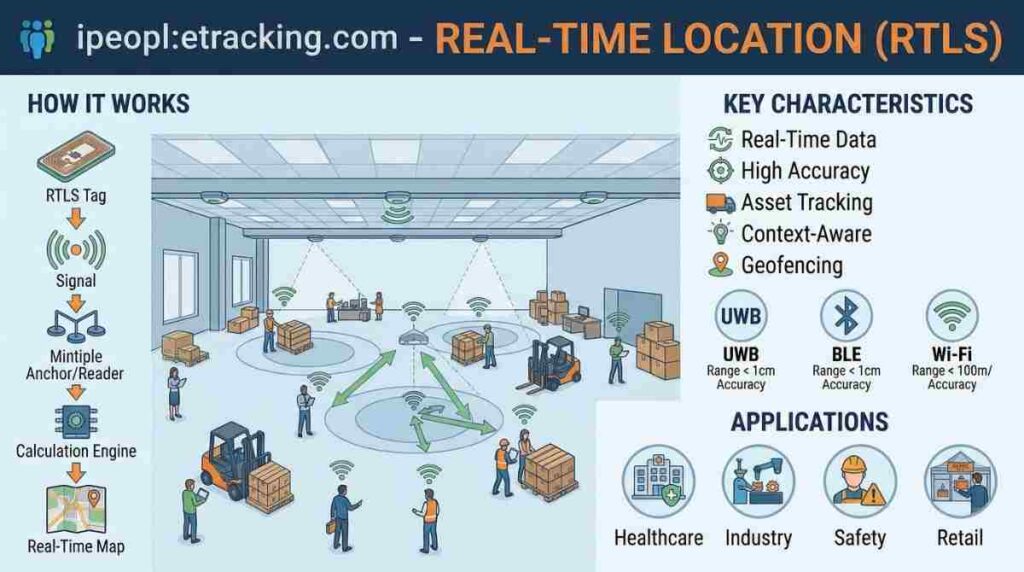
Real-Time Location Tracking System for Enhanced Operational Control
RTLS (Real-Time Location Systems) provides a powerful and scalable solution for accurately monitoring the movement of individuals in real time across various environments. Utilizing advanced Radio Frequency Identification (RFID) technologies, RTLS enables precise location tracking to enhance visibility and decision-making.
By delivering continuous insights into people’s movements, RTLS improves safety protocols, automates attendance tracking, and optimizes workflows across industries such as healthcare, education, and construction. These systems can be integrated and customized to meet the specific needs of any organization, ensuring efficient implementation and impactful outcomes.
Core Components
Hardware
- RTLS-enabled RFID wristbands and badges – People Tracking RFID Tags and Wristbands provide precise, real-time location monitoring for personnel and visitors.
- Wearable RFID readers – Wearable RFID Readers capture location and tag data in real-time for mobile workforce and asset tracking.
Software
- Real-time location dashboard
- Alerting and notification systems
- Historical movement replay and analytics
Cloud Services
- Scalable cloud-based location data storage
- Remote access via secure portals
- API for third-party system integration
Key Features and Functionalities
- Real-time location detection with high precision
- Zone-based tracking and alerts
- Automated access control integration
- Attendance monitoring and reporting
- Geofencing capabilities
- Data logging and historical movement reports
Integrations and Ecosystem Compatibility
- Seamless API integration with HR and security systems
- Compatible with BLE, GPS, and UWB tracking technologies
- Integrates with cloud-based platforms for remote access and management
- Works alongside mobile and desktop interfaces for flexibility
Benefits
- Improved operational visibility and efficiency
- Reduced manual tracking and reporting errors
- Enhanced safety and compliance
- Instant notifications and alerts for unauthorized movements
- Informed decision-making with analytics and insights
Real-World Applications & Use Cases
- Healthcare Facilities
Track patients, staff, and assets to improve care coordination and safety. - Educational Campuses
Monitor student attendance and campus movement for security and incident response. - Construction Sites
Manage worker locations, zone compliance, and emergency evacuation plans. - Event Venues
Track crowd flow, monitor staff, and optimize real-time safety operations. - Manufacturing Plants
Ensure worker accountability, safety compliance, and zone-based access control.
Industries We Serve
- Healthcare & Hospitals
- Construction & Infrastructure
- Education & Universities
- Government & Defense
- Manufacturing & Industrial Facilities
Case Studies

Austin, Texas
A government building implemented RTLS-based RFID badges to monitor the presence and movement of employees and contractors. This enhanced security and allowed for fast evacuations and incident response.
Chicago, Illinois
A regional hospital integrated an RTLS solution to track nurses and high-risk patients throughout multiple wings. The system provided live location visibility and helped reduce response times for patient care.
Toronto, Ontario
A pharmaceutical R&D center in Toronto used RTLS to track personnel entering clean zones. The solution enforced access protocols and provided detailed logs for regulatory reporting and safety audits.
Relevant U.S. & Canadian Industry Standards and Regulations
- ISO/IEC 24730
- FCC Part 15
- OSHA 1910.38
- CSA Z94.4
Our Commitment to You
Headquartered in Arlington, VA, we are a trusted leader in people tracking innovation. With strong B2B networks across North America, our focus is on delivering reliable, scalable, and intelligent RTLS solutions. Backed by a commitment to quality assurance, continuous product innovation, and strategic industry partnerships, we empower organizations to streamline operations with confidence. Our solutions also complement industrial fleet and workforce tracking technologies that help organizations improve operational visibility and resource coordination.
Ready to explore how RTLS can transform your tracking capabilities?
Contact IPEOPLE TRACKING today for personalized support, technical inquiries, or a product demo.
Frequently Asked Questions About RTLS
Learn how real-time location systems work, which tracking technologies they use, and how RTLS solutions help businesses monitor people, equipment, and assets.
What is a real-time location system (RTLS)?
A real-time location system (RTLS) automatically identifies and tracks the location of people, equipment, or assets inside a defined area. It uses technologies such as UWB, BLE, Wi-Fi, or RFID to collect signals and displays positions in tracking software, usually on a digital map.
How does an RTLS tracking system work?
Tags or badges send wireless signals to fixed sensors, readers, or anchors. Positioning software uses those signals to estimate each tag's location and shows it on a dashboard. The system can also send zone alerts and keep movement history for reports.
What technologies are used in RTLS?
RTLS can use Ultra-Wideband (UWB), Bluetooth Low Energy (BLE), Wi-Fi, active RFID, infrared, ultrasound and, outdoors, GPS. Each offers a different balance of accuracy, range, cost, and infrastructure. Many deployments combine more than one technology to cover different areas or tracking needs.
What is the difference between RTLS and RFID?
RTLS is a complete system for tracking location in real time, and it can be built on several technologies. RFID is one identification technology that an RTLS may use. Passive RFID mainly records where a tag was read, while active RFID can support more frequent location monitoring when deployed with suitable readers and infrastructure.
Can RTLS track employees in real time?
Yes. RTLS can track employee locations when workers carry compatible tags or badges and the facility has the required infrastructure. The system can display their estimated positions on a map and trigger zone alerts. Employee tracking should follow applicable privacy laws, internal policies, and clear notice to staff.
How accurate are real-time location systems?
RTLS accuracy depends on the technology, the number and placement of anchors or readers, and the building environment. UWB can provide highly precise positioning, BLE commonly supports proximity or zone-level detection, and Wi-Fi positioning often provides broader location estimates. Actual accuracy varies by deployment.
What is the difference between indoor positioning and GPS?
GPS uses satellites and works best outdoors, where it has a clear view of the sky. Indoor positioning systems use local infrastructure such as UWB anchors or BLE receivers, allowing location tracking inside buildings where GPS signals may be weak or unavailable.
How much does an RTLS system cost?
The cost of an RTLS system depends on facility size, number of tags, infrastructure, required positioning accuracy, software features, and integrations. A small BLE deployment may cost considerably less than a multi-building UWB system. Contact IPEOPLE TRACKING to discuss your requirements and request a tailored quote.
Where are RTLS solutions commonly used?
RTLS solutions are commonly used in healthcare, manufacturing, construction, education, warehousing, and event venues. Organizations use them to improve staff safety, support emergency response, increase workflow visibility, and locate people or equipment more efficiently.
Can RTLS integrate with existing security systems?
Yes, many RTLS platforms can integrate with existing security and facility management systems through APIs and supported integrations. RTLS location data can be shared with access control, alarm, and facility platforms to support monitoring and automated workflows. Integration depends on system compatibility and available software capabilities.