
RFID Wristbands for People Tracking, Identification & Access Control
iPeople Tracking provides Advance RFID wristband solutions that help organizations identify people, manage access, record attendance, and monitor movement through reader-defined zones.

What Are RFID Wristbands?
RFID wristbands are wearable identification devices that contain a small RFID chip and antenna. They communicate with RFID readers using radio-frequency signals to identify the wearer and link their unique ID to information stored in a tracking or access-control system. Depending on the RFID technology and reader setup, they can support identification, attendance management, access control, and location-event monitoring.
They are part of iPeople Tracking’s RFID tracking solutions.
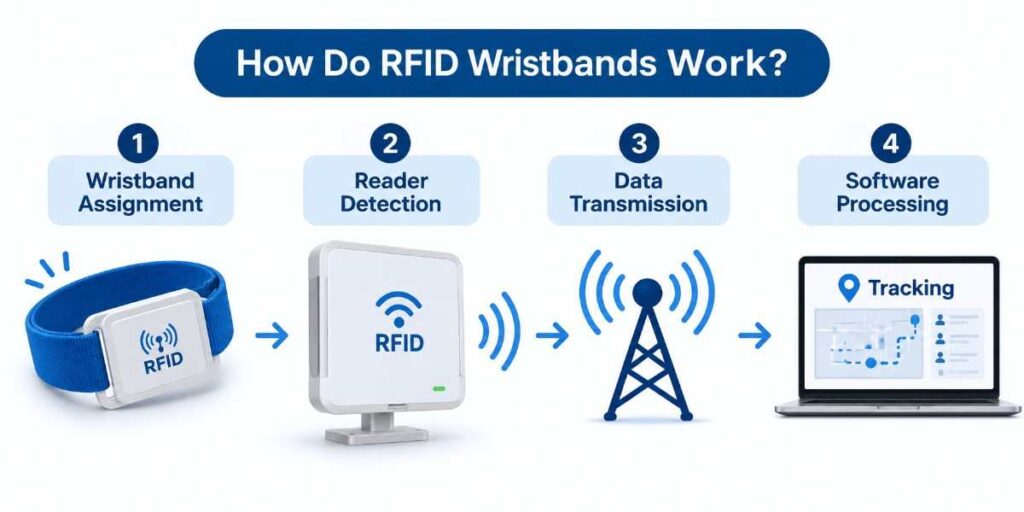
How Do RFID Wristbands Work?
- Wristband assignment: Each wristband contains an RFID tag with a unique identifier, which is assigned to a person.
- Reader detection: An RFID reader sends a radio-frequency signal to detect or communicate with the tag.
- Data transmission: The tag responds with its identification information.
- Software processing: The connected system matches the identifier with a person or record and acts, such as recording attendance or checking access permissions.
Wearable RFID Solutions for People Tracking
RFID wristbands provide a proven solution for secure identification, real-time tracking, and access control across various industries. These wearable devices are designed for durability, comfort, and continuous operation, especially in high-traffic or mission-critical environments.
By integrating with access control systems, tracking dashboards, and databases, RFID wristbands streamline attendance logging, zone monitoring, and compliance enforcement. They are widely adopted in healthcare, education, public events, manufacturing, and corrections.
RFID Wristband System Components
Hardware
- Advanced people-tracking RFID wristbands and tags (passive/active, ergonomic design) – People Tracking RFID Tags and Wristbands enable real-time location tracking, identity verification, and anti-tamper protection for healthcare, events, and correctional facilities.
- Rugged LF RFID wristbands (silicone, fabric, disposable, tamper-evident) – Wristband LF RFID Tags designed for short-range human identification and secure zone access in healthcare, education, events, and industrial zones.
- Wearable UHF RFID Wristband Tag — Wearable UHF RFID Tags for people tracking, designed for enhanced durability and comfort.
Software
- User-friendly interface for access control, attendance logs, and analytics
- Role-based permission settings and tracking dashboards
Cloud Services
- Real-time data storage, syncing, and remote access capabilities
- Secure user authentication and device management systems
Key Features and Functionalities
- Contactless Scanning: Enables rapid, secure data transfer via RFID readers
- Anti-Tamper Design: Prevents unauthorized removal or reuse
- Customization Options: Logos, colors, and variable data printing
- Waterproof and Dustproof: Ideal for outdoor and healthcare settings
- Multiple Frequency Support: Compatibility with diverse RFID systems
Integrations and Ecosystem Compatibility
- Works with RFID readers, access control panels, and cloud dashboards
- Compatible with iPeopleTracking platforms and third-party tracking systems
- API support for seamless software integration
Benefits
- Enhanced Safety: Real-time alerts for unauthorized movement
- Efficient Access Control: Reduce queues and manual checks
- Improved Compliance: Easily track attendance and site regulations
- Durability and Comfort: Designed for extended wear in diverse conditions
- Scalable Solutions: Suitable for small facilities to large organizations
Real-World Applications & Use Cases
- Hospitals & Elderly Care – Monitor patient movements and streamline medical workflows
- Schools & Camps – Track students, automate attendance, and ensure child safety
- Construction Sites – Enforce zone access and safety compliance
- Events & Venues – Manage entry and reduce wait times with automated access
- Correctional Facilities – Track inmate movement and staff coverage in secure zones
Industries We Serve
- Healthcare
- Education
- Public safety
- Event management
- Manufacturing and logistics
- Hospitality and entertainment
RFID vs. NFC Wristbands: What Is the Difference?
NFC (Near Field Communication) is a short-range wireless technology within the broader family of high-frequency (13.56 MHz) RFID. It enables devices and compatible wristbands to exchange information when brought close to an NFC reader, making it suitable for applications such as employee identification, contactless access control, event check-ins, and payment transactions. Unlike some other RFID systems, which can support different reading distances and applications, NFC is primarily designed for intentional, close-range interactions. Organizations can choose between NFC and other RFID technologies based on their required reading range, security requirements, reader compatibility, and tracking application. Learn more about Near Field Communication (NFC) and explore CommCon AI’s RFID and NFC-based construction access control solutions for applications involving workforce credentials, site entry authorization, and restricted-area access.
Case Studies

Chicago, Illinois
An urban hospital integrated RFID wristbands to monitor patient movement between departments, enabling faster response times and reducing wait durations across emergency care units.
Austin, Texas
A public school district introduced RFID wristbands to track student entry/exit, manage bus boarding, and notify parents, boosting attendance monitoring accuracy and child safety.
Toronto, Ontario, Canada
A large event arena deployed RFID-enabled wristbands for access control and crowd management, allowing real-time analytics on visitor flow and reducing unauthorized access incidents.
Relevant U.S. & Canadian Industry Standards and Regulations
- ISO/IEC 18000
- FCC Part 15 Compliance
- CSA Group Standards
- Health Insurance Portability and Accountability Act (HIPAA)
- Personal Information Protection and Electronic Documents Act (PIPEDA)
For more information on how RFID wristbands can transform your people’s tracking operations.
Contact IPEOPLE TRACKING. Our team is here to provide expert guidance, tailored solutions, and responsive support to meet your organization’s needs.
Frequently Asked Questions About RFID Wristbands
Learn how RFID wristbands work, where they are used, how they support people tracking, and what to consider when selecting an RFID wristband system for your organization.
What are RFID wristbands used for?
RFID wristbands are used for identification, access control, attendance, and zone-based monitoring. Common settings include hospitals, events, schools, hotels, and industrial sites. A reader detects the wristband's unique ID, and software links it to a person or record to trigger an action.
How do RFID wristbands work?
Each wristband contains an RFID chip and antenna with a unique ID. A reader sends a radio signal, the tag responds with its ID, and the tracking software matches the ID to a person and acts, such as recording attendance or checking access permissions.
Can RFID wristbands track people?
RFID wristbands can identify people at designated reading points or within configured detection zones. Passive wristbands generally identify a person when they enter a reader's range, while specialized active systems can support more frequent location monitoring. Capability depends on the tag type, reader infrastructure, and software.
What is the difference between passive and active RFID wristbands?
Passive wristbands have no battery and respond using energy from a reader, which suits access control and attendance. Active wristbands contain a battery and transmit signals themselves, supporting longer range and more frequent location updates, but they cost more and need battery management.
What is the difference between RFID and NFC wristbands?
NFC is a short-range technology within high-frequency (13.56 MHz) RFID, typically used for close taps such as access or payments. Other RFID wristbands, including UHF types, can be read at different distances. The right choice depends on range, compatibility, and the application.
Are RFID wristbands waterproof?
Many silicone RFID wristbands are designed to resist water, but water resistance depends on the product's construction and tested rating. Check the manufacturer's specifications before using a wristband for swimming, showering, or wet industrial environments.
How far can an RFID wristband be detected?
Read range depends on the frequency, tag type, reader, antenna, and environment. HF and NFC wristbands are typically read at short distances, while UHF and active systems can be detected from further away. Test wristbands on the wrist in the real environment to confirm range.
Can RFID wristbands be reused?
Many silicone and durable fabric RFID wristbands can be reassigned and reused, while disposable wristbands are designed for one-time use. Reuse depends on the construction, closure, and how the system manages reassignment and data. Confirm with the product specification.
Are RFID wristbands suitable for hospitals?
Yes, they can support patient and staff identification, controlled access, and zone monitoring when paired with the right readers and software. Hospitals should check comfort, hygiene, durability, and privacy requirements, and evaluate applicable rules such as HIPAA for their deployment.
How much does an RFID wristband system cost?
Cost depends on the number of wristbands, the frequency and type, the readers and antennas needed, the software and integrations, and the size of the deployment. A needs assessment is the best way to estimate the cost of a solution suited to your site.
Looking for the Right RFID Wristband Solution?
Discuss your identification, access control, and people tracking requirements with our team.